Too Busy To Know We’re Not That Busy, Australia’s New Nudge Unit, plus more weekly links

A selection of recent behavioral science news, articles, and resources of note:
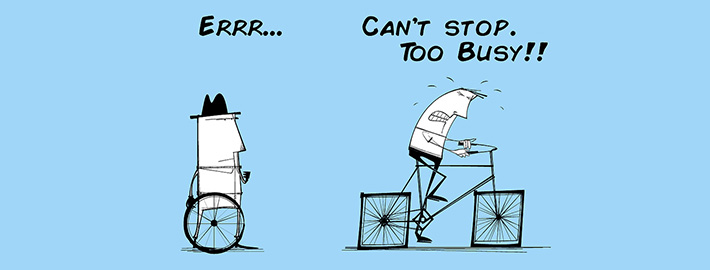 Image: Alan O’Rourke and WorkCompass.com
- Our constant influx of incoming messages, emails, and notifications deems us the busiest generation yet, right? According to the U.K.’s Centre for Time Use Research, this is only a myth. After comparing time diaries from the 1960’s to those of today, researchers found little evidence that today’s generation is working any harder than those in the past. So maybe you do have time to learn a new recipe, write your friend, or brush up on your French. (Fast Company)
- Following the lead of the UK’s Behavioral Insights Team and the White House Social and Behavioral Sciences Team, Australia announced the launch of BETA, the Behavioral Economics Team of the Australian Government. In collaboration with seven federal government agencies, BETA will aim to use insights from behavioral science to improve policy for Australian citizens. (The Mandarin)
- In a new series exploring financial decision-making traps with quite costly consequences, Marketplace’s David Brancaccio spoke with Behavioral Economist Colin Camerer about the ways “Sticking to your goals is costing you” and took a tip from Behavioral Scientist Abigail Sussman on how to “Dip into your savings and don’t be sorry”. (Marketplace)
- Texting patients to remind them of their appointment and inform them of the cost to the health service if they miss it—160 pounds—could save Britain’s National Health Service 1 million pounds a week. An additional 100,000 organ donors joined Britain’s donor registry after a simple phrase was added to the sign up form: “If you needed an organ transplant would you have one? If so, please help others.” Imperial College London’s Professor Lord Ara Darzi explains how “Great communication in healthcare can save lives.” (The Guardian)
- In a recent article in Scientific American, Scott Barry Kaufman wonders what school might look like if educators move beyond an academic growth mindset and aim instead to cultivate a personal growth mindset in their students. (Scientific American)
- “A warmer embrace of Muslims could stop homegrown terrorism” suggest Psychologists Sarah Lyons-Padilla and Michele Gelfand. (The Conversation)
- “Solitary confinement,” said Supreme Court Justice Anthony Kennedy, “literally drives men mad.” So why are prisons still keeping some people isolated year after year after year? (USA Today)